Last updated: February 2026 · Reviewed by the editorial team behind our iGaming research and testing project · 19+ / 18+ depending on your province
Baccarat Online: Rules, Demo Play, Live Casino Tables and Real-Money Betting Explained
Provider
Evolution
RTP
98.94%
Min bet
€0.10
Max bet
€1,000.00
Max win
9 000 x bet

Everything Important in 60 Seconds
- What it is:Baccarat is a fixed-rules card game where you bet on one of three outcomes: Player, Banker or Tie. You never build a hand. You predict which of the two dealt hands lands closest to 9.
- Card values:2–9 count at face value, Ace = 1, 10 / J / Q / K = 0. If a total goes above 9, the first digit is dropped (8 + 7 = 15 → 5).
- Best mathematical bet:Banker, house edge 1.06% (win probability 45.86%, paid 1:1 minus 5% commission). Player: 1.24% (44.62%). Tie: 14.36% at 8:1, the single worst bet on the table.
- Best online formats:RNG tables (fast, low stakes), live dealer studios (Evolution's First Person Baccarat quotes 98.94% RTP), and baccarat demo mode for learning the interface without money.
- Where Canadians play:Ontario residents use operators licensed by iGaming Ontario; the rest of Canada typically plays on Kahnawake- or MGA-licensed sites with CAD balances and Interac payments. Minimum age is 19+ in most provinces, 18+ in Alberta, Manitoba and Quebec.
- Bonuses:baccarat usually contributes 0–10% toward wagering requirements, and "betting both Banker and Player at once" is almost always a bannable low-risk pattern. Read the terms line by line before you deposit.
- Hard truth:no betting system beats the house edge. The peer-reviewed and preprint literature is unanimous. Progressive systems change variance, not expectation.
Why This Guide Matters Before Your First Deposit
Baccarat looks like the easiest game in any online casino lobby. Three betting spots, no decisions, one number to remember. That simplicity is exactly what makes it expensive when nobody explains the fine print.
Here is what usually goes wrong for a Canadian player. You accept a welcome bonus built for slots, sit down at a live baccarat table, and later discover the table games contributed 5% toward wagering. Or you back Tie because the payout looks generous, without knowing that bet costs thirteen times more than Banker. Or you win, request a withdrawal, and only then get asked for verification documents.
None of that is bad luck. It is unread information.
So this guide covers the game and the context around it: rules, odds, the eight main variants, the scoreboards, live dealer mechanics, provincial licensing, Interac withdrawal timelines, bonus contribution rates, and the research on how baccarat players actually behave. Read it once, and the lobby stops being a guessing game.
What Baccarat Is and What Games Are Available Online
Baccarat is a comparing card game with almost no player agency. Two hands are dealt, one called Player (Punto) and one called Banker (Banco), and your only decision is which outcome to back before the cards come out. The hand whose total is closest to 9 wins. That is the entire objective.
This is why baccarat has historically been the "whale" game. The house edge on the two main bets is among the lowest anywhere on the casino floor, table limits are among the highest, and the decision load is close to zero. A high roller can wager enormous sums per hand without mastering a decision matrix the way blackjack demands.
The round, step by step:
- Choose a table and stake. In RNG and live formats, minimums start around $0.20–$1 and maximums run from $500 to $10,000+ depending on the table and licence.
- Place your bet on Player, Banker or Tie, plus optional side bets such as Player Pair or Banker Pair.
- Two cards go to each hand. Aces count 1, tens and picture cards count 0.
- Check for a natural. If either hand totals 8 or 9 on two cards, that is a Natural. No further cards are drawn and the round settles immediately.
- Apply the third-card rules if no natural occurred. These are fixed and mechanical. Neither you nor the dealer chooses, except in Chemin de Fer and European Baccarat (see Section 5).
- Compare totals. The highest final total modulo 10 wins. Equal totals mean a Tie: Player and Banker bets push in most rule sets, and the Tie bet wins.
A worked example of a full round. You bet $10 on Banker. The player hand receives 7♦ + 8♣ = 15 → 5. Banker receives K♠ + 4♥ = 4. Does Player stand on 5? No. Player draws on 0–5, so a third card comes out: 2♠ → total 7. Banker holds 4, and the Player's third card was a 2, which falls inside the 2–7 draw window for a Banker total of 4. So Banker draws: 9♦ → 4 + 9 = 13 → 3. Player 7 beats Banker 3. Your Banker bet loses.
Notice how much happened without a single decision from you. That is baccarat in one paragraph.
1.1 Baccarat Demo and Free Play
Every serious lobby ships an RNG table in free mode. A baccarat demo runs the same certified ruleset as the paid version, so you can learn the bet spots, the commission box, the rebet button and the third-card sequence at zero cost. That is the honest use case: mechanics.
What a demo cannot teach you is money management. The practice balance is usually $10,000 or more, which bears no resemblance to a real budget. If you flat-bet fake money at $100 a hand and finish ahead, you have learned nothing transferable. Play the demo at the stake you actually intend to use.
One more practical note: free baccarat games are almost always RNG only. Live studios cost the operator money per round, so they are not offered in demo.

1.2 Baccarat Live Dealer and Live Casino Tables
Live baccarat streams from a licensed studio with a human dealer, a physical shoe and real cards on a marked table. You bet through the interface during an open window, and optical recognition reads the cards and settles automatically.
The appeal is verifiability and pace. You watch the cards leave the shoe. Rounds are slower than RNG, typically 30 to 48 seconds, which happens to be cheaper per hour. The trade-off is bandwidth sensitivity and fixed betting windows: miss the window and you sit the hand out.
Live baccarat live casino sections usually list several speeds and rule sets side by side: Speed Baccarat, Lightning Baccarat, No Commission, First Person and Dragon Tiger. Section 8 covers the interface in detail.

1.3 Baccarat Real Money: Playing With Your Own Funds
Real-money baccarat adds three things the demo does not have: a verified account, a payment rail and consequences. Before you make that switch, confirm four items. The licence. The CAD balance. The withdrawal method and its timeline. The bonus contribution rate for table games.
That order matters. A generous offer on a site you cannot cash out from is worth nothing. If you want to compare compliant lobbies rather than take a banner's word for it, start from an online casino with licensed, certified table games, then run the checklist in Section 17 before you deposit a dollar.
Card Values and Scoring
The single most common beginner error is misreading totals above 9. Baccarat uses modulo-10 arithmetic. The tens digit is simply discarded, and nothing else about the count is complicated.
| Card | Value | Example hand | Final hand score |
|---|---|---|---|
| 2 – 9 | Face value | 7 + 8 = 15 | 5 (the leading "1" is dropped) |
| 10, J, Q, K | 0 points | K + 9 = 9 | 9 (Natural, best possible hand) |
| Ace | 1 point | A + 4 + 3 = 8 | 8 (a three-card 8) |
| Mixed example | — | Q + 6 + 7 = 13 | 3 |
| Mixed example | — | A + 9 = 10 | 0 (the dreaded "baccarat") |
Three consequences follow from this scoring system.
- No hand can bust. Unlike blackjack, there is no total to exceed. The exception is Macao, the historical precursor where hands above 9 do bust (Section 5).
- 9 is the ceiling, 0 is the floor. A total of 0 is literally called "baccarat", from the Italian and French word for zero.
- Card counting is nearly worthless here. Because tens and picture cards are zeros and hands cannot bust, the composition of the remaining shoe moves the edge only marginally, and almost always too late in the shoe to matter.
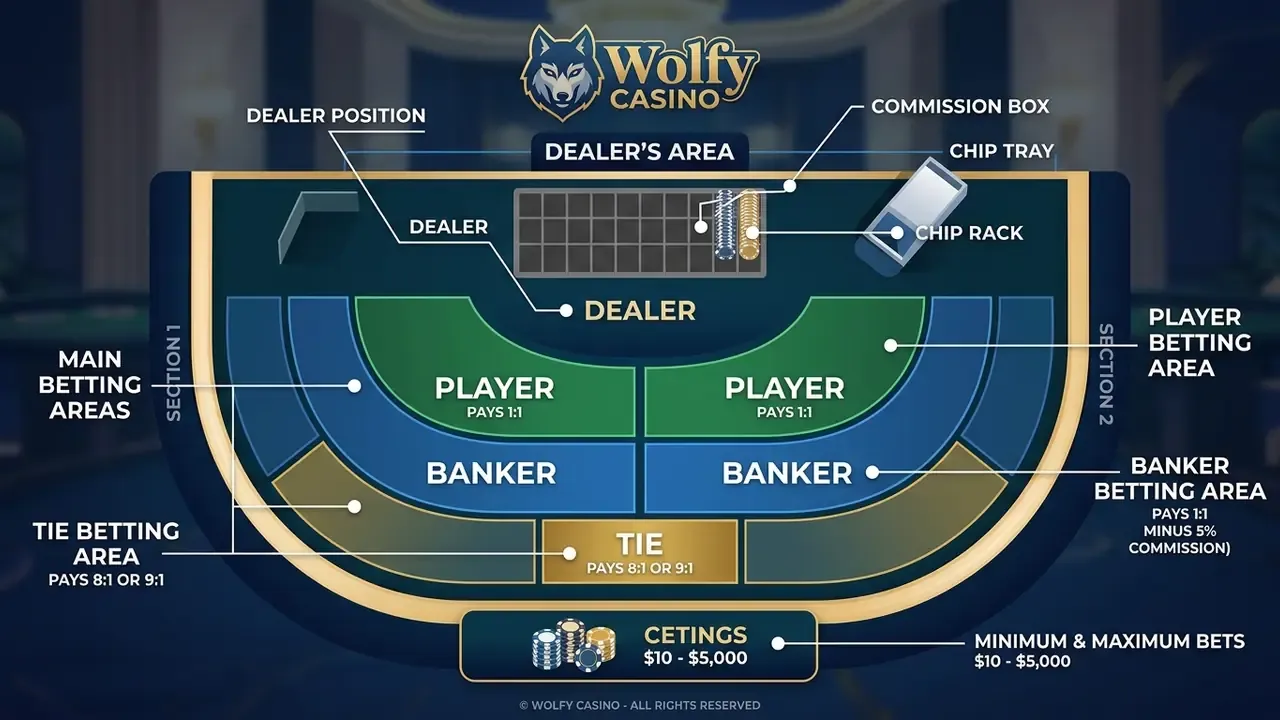
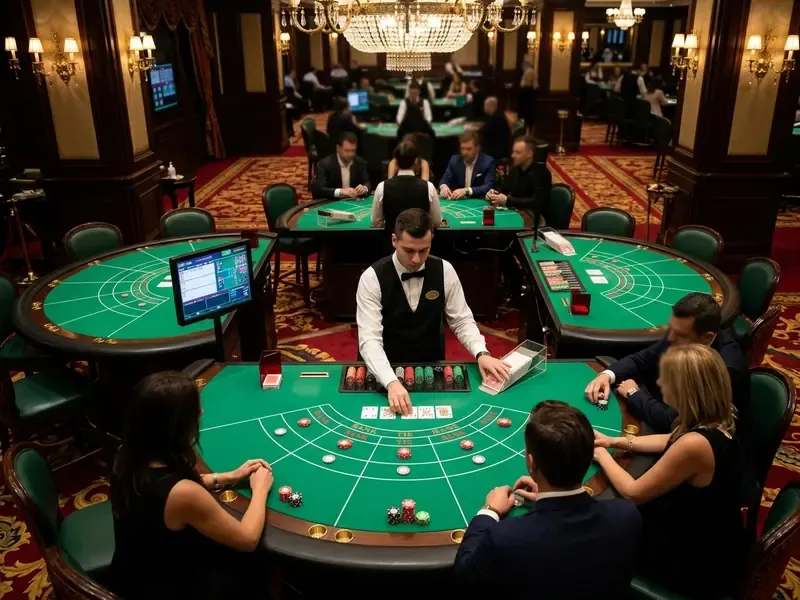
Reading the table layout takes ten seconds once you know the zones. Three main betting areas sit in front of you: Player, Banker and Tie. The dealer stands behind the shoe. The commission box, a numbered grid where the dealer tracks the 5% owed on Banker wins, sits to the dealer's side. Pair bet spots usually flank the Player and Banker zones.
The Third-Card Rule, Step by Step
The third-card rule intimidates newcomers. But in Punto Banco, the version you will meet in virtually every online lobby, the software or the dealer applies it automatically. You never act. Understanding it simply makes the game legible.
Round sequence, in order: place your bet → two cards are dealt to each hand → check for a natural 8 or 9 → apply the third-card rules if needed → compare the final totals → the winning hand is paid.
3.1 When the Player Hand Draws a Third Card
- Total 0–5:the player hand must draw a third card.
- Total 6 or 7:the player hand stands.
- Total 8 or 9:Natural. The deal ends, and no third cards appear at all.
No judgment call exists at any point. This is why baccarat rewards patience rather than technique.
3.2 When the Banker Draws a Third Card
If the player hand did not draw, the Banker follows the same simple pattern: draw on 0–5, stand on 6–7.
If the player hand did draw, the Banker's action depends on both its own total and the value of the Player's third card:
| Banker's two-card total | Banker draws when Player's third card is… | Banker stands when Player's third card is… |
|---|---|---|
| 0, 1, 2 | Always draws | — |
| 3 | 0, 1, 2, 3, 4, 5, 6, 7, 9 | 8 |
| 4 | 2, 3, 4, 5, 6, 7 | 0, 1, 8, 9 |
| 5 | 4, 5, 6, 7 | 0, 1, 2, 3, 8, 9 |
| 6 | 6, 7 | 0, 1, 2, 3, 4, 5, 8, 9 |
| 7 | Always stands | All |
| 8, 9 | Natural, deal is over | All |
3.3 Why This Matters for Your Bet Choice
The Banker acts after seeing what the Player did. That single asymmetry is why the Banker hand wins slightly more often than the player hand, 45.86% versus 44.62% of all hands including ties, and why casinos charge a 5% commission on winning Banker bets.
Without that commission the Banker bet would carry positive expectation, and no casino on earth would offer it. The commission is not a fee. It is the correction that makes the bet profitable for the house.
Betting Odds, House Edge and Side Bets
4.1 The Three Main Bets
| Bet | Wins when | Payout | Probability (8 decks) | House edge |
|---|---|---|---|---|
| Banker | Banker total is closer to 9 | 1:1 minus 5% commission (19:20) | 45.86% | 1.06% ✅ best bet |
| Player | Player total is closer to 9 | 1:1 | 44.62% | 1.24% |
| Tie | Both totals are equal | 8:1 (sometimes 9:1) | 9.52% | 14.36% at 8:1 · ≈4.84% at 9:1 ⚠️ |
Excluding ties, which push the main bets, Banker wins roughly 50.68% of decided hands. The mathematics is straightforward: expected value is win probability multiplied by payout, minus loss probability multiplied by stake.
«The expected win is calculated as the difference between the product of win probability and payout odds and the product of loss probability and loss odds.» — Commentary on Statistical Estimation of Gaming Outcomes (source [3] of our research file)
Applied to baccarat: HE = 1 − (P(win) × payout + P(push) × 1). Feed in 0.4586 and 0.95 for Banker, and you land on the familiar 1.06%.

4.2 Why the Tie Bet Is a Budget Trap
A 9.52% event paid at 8:1 carries a 14.36% house edge, roughly thirteen times worse than the Banker bet. On a $10 flat stake, 100 Banker hands cost you about $10.60 in expectation. One hundred Tie hands cost about $143.60.
The Tie bet is priced like a lottery ticket and behaves like one. Casinos display it prominently for exactly that reason. If you take one number away from this article, take this one.
4.3 No Commission and EZ Baccarat Rule Variations
Some tables remove the 5% commission and instead pay 1:2, meaning half, when the Banker wins with a total of 6. Convenient, and slightly more expensive: the effective house edge on Banker rises to roughly 1.46%.
Other tables in the EZ Baccarat family push the Banker bet when Banker wins with a three-card 7, landing at approximately 1.02%, marginally better than the classic commission model. Always read the paytable panel before you sit down. The same game name can hide different maths, and the difference is real money over a session.
4.4 Side Bets: Pairs, Tiger Bets, Egalité, Dragon Bonus
| Side bet | Wins when | Typical payout | Risk profile |
|---|---|---|---|
| Player Pair / Banker Pair | First two cards of that hand form a pair | 11:1 | House edge roughly 10–11% (8 decks) |
| Either Pair | Either hand makes a pair | 5:1 | High variance, high edge |
| Perfect Pair | Suited pair | 25:1 | Very high edge |
| Egalité | Tie on one specific total, e.g. Tie on 4 | 40:1 to 200:1+ | Lottery-style; edge varies enormously by total |
| Dragon Bonus / Tiger | Natural win, or a win by a large margin | 1:1 up to 50:1 | Marketed as "value"; mathematically worse than Banker |
Side bets exist to raise the average house edge of the table. Every one of them is priced well above the 1.06% Banker bet, which is why bankroll-focused guidance steers players toward the main bets and leaves the pair spots empty.
[Requires primary-source confirmation] Our research file did not identify a specific 2023–2026 responsible-gambling publication that names baccarat side bets explicitly. The recommendation to avoid them rests on the arithmetic of their published paytables, not on a cited behavioural study. Treat it as a mathematical inference rather than a regulatory position.
Fact-check note. Third-card sequences, payouts and commission rules in Sections 3 and 4 were cross-checked in February 2026 against published rule sheets from Evolution, NetEnt and Pragmatic Play, plus standard eight-deck baccarat probability tables. Where a specific table differs, the operator's own paytable panel governs. Verify it in the game window before your first bet.
The Eight Main Baccarat Variants
Punto Banco, Chemin de Fer and Baccarat Banque are the three historical pillars. The rest are commercial or regional derivatives. Trying several is worthwhile, because the differences change pace and agency far more than they change the maths.
5.1 Punto Banco
The default. The casino banks every hand, players only bet on outcomes, and all drawing decisions are fixed by table rules. This is what "baccarat" means in North America and in roughly 95% of online lobbies.
5.2 Chemin de Fer
French for "railroad". Here players compete against each other rather than against a house banker. The bank rotates around the table, and the banking player has genuine discretion over whether to draw a third card. Because it needs multiple human participants, a faithful online simulator of Chemin de Fer is rare.
5.3 Baccarat Banque (Baccarat à deux tableaux)
Also player-banked, but the bank is more stable: one player holds it for an extended run rather than passing it every hand, and two Player hands are dealt against a single Banker hand. Players are not competing against each other the way they do in Chemin de Fer. Mostly a land-based European format.
5.4 3-Card Baccarat
Despite the name, structurally different from Punto Banco. Both hands always receive exactly three cards, and the number of picture cards in each hand feeds into determining the winner. Gameplay runs considerably faster than the standard variety.
5.5 Mini Baccarat
The same Punto Banco ruleset on a smaller table, with lower limits and a faster pace. One dealer handles everything and players never touch the cards. Online, Mini Baccarat is often the cheapest entry point, and the most useful table for practising with realistic stakes rather than the fictional $10,000 balance a demo hands you.
5.6 European Baccarat
Adds a blackjack-like wrinkle. The Player may choose whether to stand or draw on a total of 5, and the Banker may choose whether to take a third card. Slightly more agency, and a marginally different edge depending on how well you play the options.
5.7 Macao
An ancestor of modern baccarat rather than a variant of it. You can only bet on the player hand, not the Banker, and, uniquely, hands can bust, because totals are not reduced modulo 10 and may not exceed nine.
5.8 Dragon Tiger
A stripped-down, high-speed cousin. The two sides are renamed Dragon and Tiger, and each receives just one card. Highest card wins. Side bets include Big/Small (whether a card is above or below 7), Red/Black, Suit and Odd/Even. Typical RTP sits lower than classic baccarat, around 96.27% in Pragmatic Play's version, so it trades mathematical quality for speed.
How to Read Baccarat Scoreboards (Roads)
Those grids of red and blue circles beside every live baccarat table are not decoration. They are a formal, standardised record of shoe history, imported from Macao and Asian casino floors. Five boards are standard.
«Whether you care about the Bead Plate, Big Road, Small Road, Big Eye Boy, or the Cockroach Pig, our scoreboard has it all.» — Wizard of Odds, baccarat trainer documentation (2024)
6.1 Bead Plate (珠盤路)
The simplest board: a chronological record, read top-to-bottom then left-to-right. Red = Banker win, Blue = Player win, Green = Tie. Small dots in the corners of each bead often flag Player Pair and Banker Pair.
6.2 Big Road (大路)
The primary trend grid. Results are recorded in columns, and a new column begins every time the winner changes. A long vertical run of red is a "Banker streak", called a "dragon" when it is very long. Frequent short columns indicate a "choppy" shoe. Ties appear as a green slash across the last result rather than as a new entry.
6.3 Derived Roads: Big Eye Boy (大眼仔), Small Road (小路), Cockroach Pig (曲直路)
These three do not record who won. They record whether the Big Road itself is repeating, each looking back a different number of columns: one for Big Eye Boy, two for Small Road, three for Cockroach Pig. A red mark means the pattern is repeating; a blue mark means the pattern broke. Players use them to classify the shoe as streaky or choppy.
6.4 What the Roads Can and Cannot Do
Roads are excellent bookkeeping and genuinely useful for discipline. They tell you how long you have been sitting there and how volatile the shoe has been.
They are not predictive. Each hand comes from a shoe whose composition barely shifts the edge, and the previous column has no causal link to the next one. Section 11 covers what happens psychologically when players forget this, and the number attached to that forgetting is larger than you might expect.
Online Formats: Demo, RNG, Live Dealer, Real Money
| Format | How you participate | Dealer present | Pace | Bet availability |
|---|---|---|---|---|
| Demo / free play | Free game interface, virtual balance | No | Fastest, no payment processing | Unlimited practice credits, no cashout |
| Virtual table (RNG) | Software-generated outcomes, certified RNG | No | Very fast, self-paced | Within the table's published limits |
| Live Dealer | Real-time video stream from a studio | Yes, human dealer | Slower; governed by real dealing and betting windows | Only during the open betting window |
| Real money | Your own funds, verified account | Depends on the table chosen | Depends on format | Constrained by balance, limits and KYC status |
7.1 Where Baccarat Sits Inside Regulated Interactive Gaming
In regulated markets, baccarat is recognised as a standard casino table game whose online versions fall under the same oversight as their land-based equivalents. That includes RNG certification, game-information disclosure and player-protection tooling.
Practically, a table on a licensed platform must publish its rules, its paytable and its limits. If you cannot find those three things in the game window, you are not on a properly regulated table. That single check filters out more bad actors than any review score.
7.2 Demo Baccarat: What the Evidence Actually Says
No match, evidence gap. We searched for 2023–2026 peer-reviewed research on whether free-play modes improve player knowledge or reduce subsequent losses, and found none in our source set. Older gambling-studies literature raised the opposite concern, that demo games may present outcomes more favourably than real-money play, but we did not obtain a citable current study either way.
Updated, defensible framing. The only verifiable claim we can make is structural. Regulatory and provider documentation indicates that demo and real-money versions of the same title run the same certified ruleset. So a demo table is a reliable way to learn the interface, the bet spots, the third-card sequence and the pace. The mechanics, not the money management.
It is a rules trainer. Not a profitability trainer. Do not extrapolate a hot demo session into a real-money staking plan.
Live Dealer Baccarat: Interface, Traffic Lights, Table Limits
Live baccarat is streamed in real time from a licensed studio. A human dealer handles the shoe, deals physical cards onto a marked table with Player, Banker and Tie zones plus a commission box, and you interact through the interface and chat rather than touching anything. Optical character recognition reads the cards and settles bets automatically.
8.1 How to Join a Live Table, Step by Step
- Register and verify an account at a licensed casino.
- Open the Live Casino lobby.
- Find the baccarat section: Speed Baccarat, Lightning Baccarat, First Person Baccarat, Dragon Tiger and so on.
- Choose a table whose minimum and maximum limits match your session budget. Not your ambitions.
- Watch the traffic-light indicator for round status.
- During the open window, select a chip value, click the Player, Banker or Tie spot, click again or press Double to increase, then wait.
8.2 The Traffic-Light System
| Signal | Meaning | What to do |
|---|---|---|
| 🟢 Green | Betting time is open | Place or adjust your bets |
| 🟡 Yellow | Betting time is nearly over | Finalise; do not start a new sequence |
| 🔴 Red | Betting time is closed | Cards are dealt; no changes possible |
Practical warning. Do not minimise your browser or switch tabs during the betting window. On several platforms this causes bets to be declined, and you sit out a hand you thought you had money on. I have seen support tickets built entirely on that misunderstanding.
8.3 Interface Features Worth Using
- Statistics panel shows Banker, Player and Tie percentages for the current shoe.
- Road maps give you all five boards from Section 6, usually collapsible.
- Rebet and Rebet & Double are convenient, and also the fastest way to escalate stakes without noticing. Use them deliberately.
- Autoplay, on RNG tables only, increases hands per hour, which increases total exposure to the house edge. Faster play does not change the edge per hand. It multiplies how many times you pay it.
Variant and Provider Comparison Table
| Game / variant | Provider | Min / Max stake | Signature feature | RTP (main bet) |
|---|---|---|---|---|
| Punto Banco / Baccarat Pro | NetEnt | $1 – $500 | Classic ruleset, Pro mode presets | 98.92% |
| First Person Baccarat | Evolution | $1 – $1,000 | 3D RNG table with a "Go Live" switch into the live studio | 98.94% |
| Lightning Baccarat | Evolution | $0.20 – $500 | Random multipliers on winning hands, up to x262,144 | 98.76% |
| Speed Baccarat | Evolution | $1 – $5,000 | 27-second rounds for high-volume play | ≈98.94% |
| Dragon Tiger | Pragmatic Play | $0.50 – $2,000 | One card per side, Dragon vs Tiger | 96.27% |
| Mini Baccarat | Play'n GO | from $0.20 | Compact, low-limit, fast | ≈98.9% |
| No Commission Baccarat | Multiple | varies | No 5% commission; Banker 6 pays 1:2 | ≈98.5% |
RTP figures are provider-published and may differ by jurisdiction and by which bet you make. The RTP quoted for a baccarat table normally refers to the optimal Banker bet. The Tie bet on the same table returns roughly 85.6%.
Provider notes worth knowing. Microgaming shipped its first baccarat in 1999. NetEnt launched Baccarat Pro in 2011 and has since added live variants. Evolution dominates the live segment with Peek Baccarat, Golden Wealth Baccarat, Lightning Baccarat and Dragon Tiger. IGT supplies electronic baccarat terminals to land-based floors as well as online clients. Betsoft, Novomatic (2017 release) and Play'n GO round out the RNG field.
One reading tip for this table: the Lightning-style multiplier games charge a fee on every bet to fund the multipliers, which is why the RTP sits below plain Speed Baccarat. Fun, but not the cheapest seat in the room.
Baccarat Strategy, Bankroll Management and Risk
⚠ Alert. No baccarat strategy guarantees a win. Raising your stake after losses increases the risk of losing your money faster, not the chance of recovering it. Set a loss limit before your first hand and treat it as fixed. This information is general in nature and is not a substitute for professional advice.
10.1 The Hard Mathematical Ceiling
Every staking system in existence, Martingale, Fibonacci, Labouchère, D'Alembert, Paroli, "follow the dragon", obeys the same identity:
Expected loss = total amount wagered × house edge.
Bet sizing changes variance and drawdown shape. It does not change expectation. A system that wins small amounts frequently is borrowing from a rare catastrophic loss. A system that loses small amounts frequently is buying a rare large win. The average is fixed by the paytable.
Nor does card counting rescue baccarat. Analysis of long-run baccarat betting concludes that even under favourable assumptions, tracking the shoe cannot produce positive expectation.
«Long-term betting in baccarat shows the house edge remains insurmountable.» — Academia.edu preprint, modelling long-run baccarat outcomes with gambler's-ruin and Markov-chain methods (source [7] of our research file). https://www.academia.edu
«Even where the Banker bet's win probability approaches 50%, the player's long-run mathematical expectation remains zero or negative.» — same preprint.
Methodological note. This document is a preprint rather than a peer-reviewed journal article, and its publication date is not stated unambiguously. We cite it because its methodology, gambler's ruin plus Markov-chain transition modelling, is transparent and reproducible, and because its conclusion aligns with standard casino-game mathematics. Weight it accordingly.
10.2 Bankroll Management: the Part That Actually Works
You cannot improve your expectation. You can control how long your money lasts, how much you expose per session, and whether you stop while you still can.
- Session bankroll, not total bankroll. Bring one session's money to one session. Forty to fifty units minimum for flat betting at one unit per hand.
- Flat betting is the honest baseline. Constant stake, Banker bet, no escalation. It minimises variance for a given number of hands.
- Set a loss limit and a win target before the first hand, and write them down. A limit you can renegotiate mid-session is not a limit.
- Cap your hands per hour. Speed Baccarat can run 100+ hands per hour. At $10 flat on Banker that is roughly $1,000 wagered and about $10.60 of expected loss per hour, before variance. Slower tables are cheaper tables.
- Use platform tooling. Regulatory frameworks in Ontario, Pennsylvania and other jurisdictions require licensed operators to provide deposit, loss, session and time limits, plus self-exclusion. Turn them on before you need them: responsible-gambling tools on a licensed platform are enforced by the operator, whereas willpower is not.
- Take breaks by schedule, not by feeling. Section 11.3 explains why that is evidence-based rather than moralising.
10.3 Two Low-Damage Progressions (With Hard Stops)
If you want structure without ruin risk, use progressions that are explicitly capped.
- Mini-Martingale. Double after each loss to recover it, but reset to your base stake after three consecutive losses, win or lose. The full Martingale's failure mode is a geometric run into either the table maximum or your entire bankroll. A three-step cap converts that catastrophic tail into a bounded, survivable one.
- 1-2-3-4 positive progression. Increase only on wins: 1 unit → 2 → 3 → 4, then reset to 1. Any loss at any step returns you immediately to 1 unit. This risks only accumulated profit during a streak and never compounds losses.
Neither system produces an edge. Both are risk-shaping tools. Say it out loud before every session: the edge is 1.06% and it belongs to the house.

10.4 Game Selection and Table Reading
- Prefer Banker. Always, mathematically, on commission tables.
- Prefer commission tables over No Commission if the alternative pays Banker 6 at half.
- Skip side bets unless you are consciously buying entertainment variance.
- Read the table for discipline, not prophecy. Observing pace, other players' behaviour and shoe volatility helps you decide when to sit out. It tells you nothing about the next card.
- Online versus land-based: with identical rules the house edge is identical. What differs is pace and experience. Live dealer tables are slower and more interactive; RNG tables are faster and therefore more expensive per hour.
Empirical Research on Baccarat Players and Gambling Behaviour
This is where most baccarat guides stop and marketing begins. It shouldn't.
11.1 Cognitive Biases and Trend-Following in Baccarat
A large observational study of casino play examined 17,970,830 baccarat hands played by 6,625 customers, and found a pattern that directly contradicts the classic gambler's-fallacy model. Instead of expecting a streak to break, baccarat bettors expect it to continue.
«Players increasingly bet on the repetition of past outcomes as a streak lengthens, demonstrating trend-following rather than anticipating reversal.» — Large-scale study of baccarat gamblers' cognitive biases, PubMed (2023–2024). https://pubmed.ncbi.nlm.nih.gov
«An analysis of 17,970,830 baccarat games across 6,625 players showed that bets on streak continuation grow as the streak extends.» — same study.
The mechanism is positive recency: the longer the red column on the Big Road, the more money piles onto red. So the roads in Section 6 are not neutral information displays. They are streak-visualisation devices that feed the exact bias the data identifies.
Knowing this is the cheapest edge available to you, because it is an edge over your own behaviour rather than over the maths.
11.2 Problem Gambling Among Baccarat-Focused Patrons
A prevalence study of casino patrons in Macao, a market where baccarat is overwhelmingly dominant, reported unusually high rates of harm within that population.
«Prevalence rates for problem gambling and pathological gambling were 15.1% and 7.1% respectively.» — Prevalence study of gambling among Macao casino patrons (2022) (sources [2][9] of our research file)
«Median monthly gambling expenditure among surveyed patrons was HK$1,845, with a range from HK$2 to HK$375,175.» — same study.
That range is the important number. The median is modest. The upper tail is not. Baccarat's combination of low edge, high limits and fast pace makes it a game where a small subset of players can lose extraordinary sums quickly while the median player looks entirely unremarkable.
11.3 Responsible Gambling Interventions: Mandatory Play Breaks
One encouraging piece of recent research examined what happens when a break is imposed rather than suggested. In a study of British online casino customers, a mandatory play break produced substantial immediate behavioural change:
«The proportion of players who stopped wagering on the day of the play break rose from 0.1% to 45%, and 44.9% did not resume play for the remainder of the day.» — Auer & Griffiths, Effect of a Mandatory Play Break on Subsequent Gambling Behaviour (2023). https://pubmed.ncbi.nlm.nih.gov
The same study reported that the share of players ceasing deposits rose sharply on the break day, from 27% to 68%.
Updated framing. The intervention studied was a platform-wide mandatory break, not a baccarat-specific one, and the study did not test game-level breaks. So the honest inference is directional rather than prescriptive: enforced interruptions measurably reduce same-day continuation, which supports the general case for scheduled breaks and session limits in fast table games. Whether a break triggered specifically after, say, 200 baccarat hands would produce the same effect has not been tested.
11.4 Regulatory Regimes and Problem Gambling Levels
Comparative regulatory analysis in the European Union has looked at whether monopoly or licensing models correlate with harm.
«In monopoly regimes, the level of problem gambling and overall consumption appeared to be slightly lower than in licensing regimes.» — EU Technical Regulation Information System, Remote Gambling and Betting Services notification documentation. https://ec.europa.eu
Read in the other direction: licensing regimes showed slightly higher problem-gambling levels and overall consumption than monopoly regimes. The differences are described as slight, and causation is not established. Market maturity, advertising volume and product mix all confound the comparison. It is a signal about market design, not a verdict on any individual operator.
Economic and Regulatory Context: Macao, Europe, North America
12.1 Macao's Gaming Economy and Baccarat's Dominance
Nowhere is baccarat more economically consequential than Macao, where baccarat alone represents nearly 85% of games-of-chance revenue.
«In the first half of 2024, Macao's gross gaming revenue reached MOP 114.07 billion, up 41.8% year on year.» — Statistics and Census Service of Macao, Gaming Statistics (2024). https://www.dsec.gov.mo
The recovery has been driven by both segments of the baccarat business at once:
«In the first quarter of 2024, VIP baccarat and mass-market gaming receipts rose 67.9% and 64.7% respectively, pushing total gaming revenue up 65.2%.» — Monetary Authority of Macao, Monetary and Financial Stability Review (2024). https://www.amcm.gov.mo
Earlier in the post-pandemic rebound, the same segments recorded far steeper year-on-year jumps, with VIP baccarat and mass-market receipts increasing by 486.1% and 404.3% respectively. That reflects an extremely low comparison base rather than sustainable growth. The structural point stands regardless of the percentage: baccarat is not one game among many in Macao. It is the load-bearing wall of that economy.
12.2 European Remote Gambling Regulation
European remote-gambling frameworks treat online baccarat as a licensable casino table game rather than a novelty. Notified national regulations typically address game-information disclosure, technical certification of RNGs, and player-protection measures. Operators may be required to publish clear game information, odds and warnings, and to implement tools such as self-exclusion and deposit limits.
[Requires primary-source confirmation] Our research file identified EU-level notification documentation on remote gambling services but did not supply an article-level citation enumerating those specific obligations. The list above reflects the common pattern across notified national frameworks. Verify the exact duties against your own regulator's published licence conditions.
12.3 North America
In the United States, state-level regimes such as Pennsylvania's require licensed interactive operators to offer deposit and loss limits, self-exclusion and session tooling, the same category of obligation described in Section 10.2. Canada's structure is provincial, and it deserves its own section.
Playing Baccarat in Canada: Licences, CAD, Interac, Withdrawals
Canada does not have one online gambling market. It has several, and which rules apply to you depends on your province.
13.1 Legal Landscape by Province
| Region | Framework | Minimum age | What it means for baccarat players |
|---|---|---|---|
| Ontario | iGaming Ontario (iGO) / AGCO-regulated private operators | 19+ | Registered operators only; local dispute resolution, mandatory RG tooling, advertising restrictions |
| Quebec | Loto-Québec (Espacejeux) | 18+ | Provincial platform; offshore access is unregulated by the province |
| British Columbia | BCLC (PlayNow) | 19+ | Provincial platform with live dealer tables |
| Alberta / Manitoba | PlayAlberta / PlayNow | 18+ (AB, MB) | Provincial platforms; private-market reform under discussion in Alberta |
| Rest of Canada | Grey market; Kahnawake Gaming Commission, MGA, Curaçao licences common | 19+ typically | No provincial recourse; due diligence on licence and payments falls entirely on you |
Note also that some promotional offers are explicitly excluded in Ontario and Alberta because of local advertising rules. That is a common footnote on Canadian casino comparison pages, and a genuine reason an offer you saw advertised may not be claimable from your address.
13.2 Payments and Withdrawal Speed for Canadian Players
| Method | CAD support | Typical deposit | Typical withdrawal | Notes |
|---|---|---|---|---|
| Interac e-Transfer / Interac Online | Yes, native | Instant | 24–72 hours | The default for Canadian bank rails; verify it is offered for withdrawals, not deposits only |
| iDebit / Instadebit | Yes | Instant | 1–3 business days | Bank-linked, widely accepted where Interac payouts are absent |
| MuchBetter / e-wallets | Yes | Instant | Hours to 24 hours | Usually the fastest non-crypto route |
| Credit / debit card | Yes | Instant | 3–5 business days | Some Canadian issuers decline gambling MCC codes |
| Crypto | Converted | Minutes | Minutes to hours | Fastest, but adds price volatility and often weaker consumer recourse |
What to verify before your first deposit, regardless of brand:
- Is the balance held in CAD, or converted, and at what spread?
- Is Interac available for withdrawals, not just deposits?
- What are the minimum and maximum withdrawal amounts per transaction and per week?
- Is there a pending or reversal period during which you can cancel a cashout back into your balance? That feature is a documented relapse risk. Disable it if the operator allows.
- Are KYC documents requested before or after your first withdrawal request? Front-loading verification prevents the classic "documents requested only when I tried to cash out" delay.
- Do table games count toward any bonus you accepted? Section 14 covers this, and it is where most disputes originate.
For low-stakes practice with real money, several international operators, LeoVegas and PlayOJO among those commonly cited, run baccarat tables from around $0.20 per hand. That lets you feel genuine decision pressure at a fraction of a live table's minimum.
Bonuses and Wagering Contribution for Baccarat
Disclaimer. Real-money play is available only to adults in jurisdictions where it is lawful: 19+ in most Canadian provinces, 18+ in Alberta, Manitoba and Quebec. Read the casino's rules, table limits and full bonus terms before you claim anything.
This section exists because bonus terms are the number-one source of withheld withdrawals for table-game players.
- Contribution rate. Slots typically count 100% toward wagering requirements. Baccarat commonly counts 0–10%, and live dealer baccarat is often excluded entirely. A $1,000 wagering requirement at 5% contribution means $20,000 of baccarat turnover. At a 1.06% house edge, that is roughly $212 of expected loss to unlock a bonus that may be worth less than that.
- Excluded-game clauses. Many welcome offers list baccarat, Dragon Tiger and all live tables under "excluded games". Wagering on an excluded game while a bonus is active can void the bonus and the associated winnings.
- Maximum bet while a bonus is active. Usually $5–$8 per hand. Exceeding it once is grounds for confiscation on most platforms.
- Prohibited low-risk betting. Covering both Banker and Player in the same round, or hedging Tie against both, is explicitly banned as "low-risk" or "equal-outcome" betting in essentially every set of terms. It is the fastest way to have an account audited.
- Cashback and comp points beat match bonuses for baccarat players. Because they are calculated on turnover rather than gated behind slot-weighted wagering, cashback, rakeback and loyalty points are usually the only promotions that genuinely improve a baccarat player's position. Look for programmes offering priority support, faster withdrawals and points redeemable as cash rather than as restricted bonus credit.
Rule of thumb. If you intend to play baccarat, decline the slots welcome bonus and ask support for a table-games or cashback offer instead. An unrestricted balance is worth more than a bonus you cannot clear. Ask that question in live chat before depositing, and save the transcript.
Baccarat Etiquette at Land-Based and Live Tables
Etiquette is not snobbery. At a baccarat table it is how you avoid slowing the game and irritating the people funding it.
- Do not touch the cards unless you are the designated banker at a big-table game and the dealer invites you to. On Mini Baccarat and all live dealer tables, the cards are never yours to handle.
- Place chips in your own betting box before the dealer calls "no more bets". Late chips are removed, not honoured.
- Do not touch your chips once the deal begins.
- Dress appropriately at high-limit land-based tables. It is not a written rule at most casinos, but it is a signal, and it affects how staff treat you.
- Stay composed. Emotional displays after a losing shoe read as inexperience, and more practically, they correlate with the loss-chasing behaviour described in Section 11.
- In live dealer chat: tipping is optional, abuse of dealers is a bannable offence, and the dealer cannot influence, predict or accelerate the shoe. Asking is pointless.
- Superstition is tolerated, not respected. Squeezing cards, calling for a "monkey", meaning a face card, and slapping the felt are all part of big-table theatre in Asian rooms. They have zero effect on outcomes.
Common Mistakes Budget Players Make
- Chasing losses. Baccarat is a game of chance, and losing sessions are inevitable. For a small bankroll, chasing is the mechanism by which a bad hour becomes a lost bankroll. Stick to the plan you wrote down before you sat down.
- Betting emotionally instead of structurally. Decisions driven by frustration, boredom or a feeling about the shoe are systematically worse than a pre-committed flat-bet plan.
- Not knowing the odds. Three numbers, 1.06% Banker, 1.24% Player, 14.36% Tie, determine everything about how long your money survives. Playing without them is playing blind.
- Over-valuing patterns and roads. Each hand is very nearly independent of the last. The Big Road records history; it does not schedule the future. The 17.9-million-hand dataset in Section 11.1 shows exactly how expensive that belief is in aggregate.
- Taking side bets "for fun" every hand. An 11:1 pair bet at roughly a 10% edge, played every hand alongside a 1.06% main bet, can more than triple your effective cost per hour.
- Playing the fastest table available. Speed Baccarat and autoplay do not change the edge per hand. They multiply the number of hands. Volume is the amplifier.
- Accepting a slots bonus and then playing baccarat. See Section 14.
- Skipping the demo table and learning the interface with real money. Chip selection, betting window, rebet, side-bet spots: all of it costs nothing to learn in demo mode.
Pre-Deposit Safety Checklist
- Licence verified. iGaming Ontario for Ontario residents; Kahnawake, MGA or another recognised regulator elsewhere. Licence number checked on the regulator's site, not the casino's footer.
- Age and jurisdiction confirmed. 19+ in most Canadian provinces, 18+ in AB, MB and QC. Online play must be lawful where you actually are.
- Baccarat table limits and paytable readable before you deposit, including whether the table charges 5% commission or pays Banker 6 at half.
- CAD balance and an Interac or equivalent withdrawal route confirmed, with limits and timeframes in writing.
- Bonus terms read: contribution rate for baccarat, max bet, excluded games, prohibited betting patterns.
- Deposit, loss and session limits set on day one, plus reality-check reminders enabled.
- KYC documents uploaded in advance to avoid withdrawal delays.
- Session budget defined in units, with a written loss limit and a stop time.
- Self-exclusion route identified in case you ever need it.
FAQ About Baccarat Online
Is the Banker bet always the best bet in baccarat?
On standard commission tables, yes. The Banker bet carries the lowest house edge at 1.06% and wins 45.86% of all hands, about 50.68% of decided ones. On No Commission tables the Banker edge rises to roughly 1.46%, which is still better than Player at 1.24%… no, correction: in that specific case Player becomes the better bet. Check the paytable before assuming.
What is the minimum bet to play baccarat online?
It depends on the operator and the table. RNG and low-limit tables start around $0.20–$1. Live dealer tables typically start at $1–$5. VIP live tables can start at $100+ and run to $10,000 or more per hand.
Can I play baccarat for free?
Yes. Most licensed casinos offer demo mode for RNG baccarat with a virtual balance. Baccarat live dealer tables are almost never available in demo, because a real dealer and studio are paid per round. Use the demo to learn mechanics only, and see the evidence note in Section 7.2.
Does baccarat count toward bonus wagering requirements?
Usually only 0–10%, and live dealer baccarat is frequently excluded outright. Always read the wagering-contribution table in the bonus terms before you accept an offer.
Can card counting beat baccarat?
No. Because tens and picture cards count as zero and hands cannot bust, shoe composition barely shifts the edge, and any favourable moments arrive too late in the shoe to exploit. Long-run modelling concludes the house edge is insurmountable.
Is online baccarat different from casino baccarat?
The rules and the house edge are the same when the rule set matches. What differs is format, pace and experience. RNG tables are faster and self-paced, live dealer tables are slower and more social, and land-based tables add ritual and etiquette.
Do baccarat games differ between casinos?
The core Punto Banco rules are stable across operators. What varies is the provider line-up, the commission model, table limits, side-bet menus and RTP on multiplier variants. Two sites can both list "Baccarat" and offer different maths, so read the in-game paytable each time.
What does "free hand" mean?
A hand dealt and resolved automatically under table rules, with no decision input from the player. In Punto Banco every hand is effectively a free hand, which is why the third-card matrix in Section 3 is executed by the dealer or the software rather than by you.
Can I play baccarat on mobile?
Yes. Both RNG and live dealer baccarat run on mobile browsers and apps, though exact device and OS support is set by the individual casino and game provider rather than by any universal standard. Live tables are more bandwidth-sensitive, and a dropped connection during the betting window can cost you a bet.
Is baccarat legal for Canadians?
Provincially regulated online gambling is legal across Canada, with Ontario operating a private licensed market through iGaming Ontario and other provinces running Crown-corporation platforms. Playing on internationally licensed sites from outside Ontario sits in a grey area: it is not prosecuted at the individual level, but you lose provincial consumer recourse. Confirm the rules for your own province.
How do high rollers manage their bankroll?
By setting deposit and time limits, dividing play into defined sessions, avoiding loss-chasing, and knowing in advance when to walk away. The bankroll is bigger. The discipline is the same one described in Section 10.2.
What is the fastest way to withdraw baccarat winnings in Canada?
E-wallets and crypto typically clear within hours. Interac e-Transfer usually takes 24–72 hours. Cards take 3–5 business days. Complete KYC before you request your first withdrawal to avoid the most common delay.
Responsible Gambling and Disclaimers
Disclaimer. This information is general in nature and is not a substitute for professional advice. Check the legislation in your jurisdiction before playing for real money.
Baccarat is entertainment with a negative expected value. No strategy, road-reading technique, progression or software tool changes that. Play only with money you can afford to lose entirely, and only where gambling is legal for you.
Practical safeguards:
- Set deposit, loss, session and time limits before your first hand, using operator tooling rather than willpower.
- Take scheduled breaks, not breaks triggered by how you feel. The evidence in Section 11.3 shows enforced interruptions substantially reduce same-day continuation.
- Never gamble to recover losses, to solve financial problems, or while impaired.
- Use self-exclusion if control becomes difficult. It is a formal, enforceable measure, not an admission of failure.
Where to get help:
- Canada:ConnexOntario (Ontario), Gamblers Anonymous Canada, and your provincial problem-gambling helpline.
- United States:1-800-GAMBLER.
- United Kingdom:GAMSTOP self-exclusion; GamCare.
- Elsewhere: your national gambling regulator publishes local support contacts.
Age requirements: 19+ in most Canadian provinces, 18+ in Alberta, Manitoba and Quebec, 21+ in several US states, 18+ in most of Europe. Operators verify age and identity via government-issued ID.
Where next? Compare on the facts, read the terms line by line, set your limits first, then choose your table. That is the whole method.
Appendices
Appendix A — Third-Card Rule Quick Reference (printable)
Player: 0–5 draw · 6–7 stand · 8–9 natural Banker (Player stood): 0–5 draw · 6–7 stand Banker (Player drew), draw if the Player's third card is:
| Banker total | 0 | 1 | 2 | 3 | 4 | 5 | 6 | 7 | 8 | 9 |
|---|---|---|---|---|---|---|---|---|---|---|
| 0–2 | D | D | D | D | D | D | D | D | D | D |
| 3 | D | D | D | D | D | D | D | D | S | D |
| 4 | S | S | D | D | D | D | D | D | S | S |
| 5 | S | S | S | S | D | D | D | D | S | S |
| 6 | S | S | S | S | S | S | D | D | S | S |
| 7 | S | S | S | S | S | S | S | S | S | S |
D = Banker draws · S = Banker stands
Appendix B — Glossary
- Baccarat (score of 0) —the worst possible hand total.
- Banco / Banker —the hand that acts second and enjoys the informational advantage.
- Bead Plate —chronological results board, red, blue and green beads.
- Big Road —column-based trend board; a new column starts on every change of winner.
- Big Eye Boy / Small Road / Cockroach Pig —derived roads tracking repetition in the Big Road at one, two and three columns of look-back.
- Commission —the standard 5% deduction from winning Banker bets.
- Dragon —an unusually long single-outcome streak on the Big Road.
- Egalité —a side bet on a tie at one specific total.
- Free hand —a hand resolved automatically with no player decision.
- Monkey —table slang for a face card, value 0.
- Natural —a two-card total of 8 or 9; ends the round immediately.
- Punto / Player —the hand that acts first under fixed drawing rules.
- RTP —return to player; the complement of the house edge for a given bet.
- Shoe —the dealing box holding, typically, eight decks.
- Squeeze —slowly revealing a card. Theatre, not strategy.
Appendix C — Cost-per-Hour Reference (flat betting, Banker, 1.06% edge)
| Stake per hand | 50 hands/hr | 100 hands/hr | 150 hands/hr (Speed) |
|---|---|---|---|
| $1 | $0.53 | $1.06 | $1.59 |
| $5 | $2.65 | $5.30 | $7.95 |
| $10 | $5.30 | $10.60 | $15.90 |
| $25 | $13.25 | $26.50 | $39.75 |
| $100 | $53.00 | $106.00 | $159.00 |
Expected loss only. Actual short-run results will deviate substantially in both directions, and that deviation is variance, not skill.
About this guide. Compiled and maintained by the editorial team behind our iGaming research project. Rules, third-card matrices and card values were cross-checked in February 2026 against published casino rule sets and provider documentation. House-edge figures reflect standard eight-deck baccarat mathematics, and RTP figures are provider-published and jurisdiction-dependent. Behavioural and market data are cited inline to their originating studies and statistical agencies, with preprint status and evidence gaps flagged explicitly wherever peer review is absent. Corrections and primary-source additions are welcome. Play responsibly, 19+.