Mines Casino Game in 2026: Full Guide to Rules, RTP, Grid Math, Strategy and Responsible Play

Last updated: February 2026 · Checked against provider documentation, regulator standards and peer-reviewed gambling research · Editorial review: Reid Calloway, independent online-casino analyst voice, Vancouver (editorial persona; no audited track record is implied)

The Short Version: What Matters in 60 Seconds

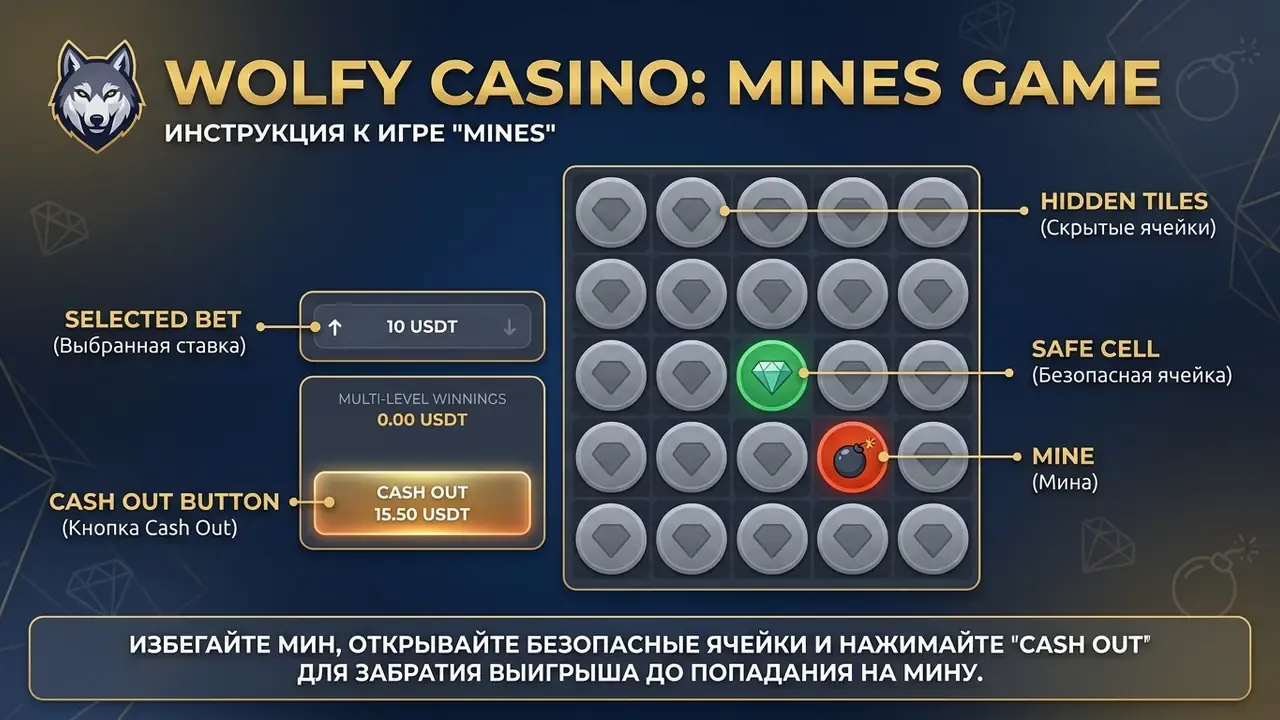
Mines is a grid-based instant casino game. You set a stake, choose how many mines are hidden on the board (most often 5×5 = 25 tiles, with 1 to 24 mines configurable), reveal tiles one at a time, and cash out at the live multiplier before you hit a mine. Every safe reveal lifts the multiplier. One mine ends the round and takes the stake with it.

Reported RTP is provider-specific and usually fixed per title: roughly 99% (Stake Originals), 98% (Hacksaw Gaming, publisher figure), 97% (Spribe) and 96% (Nyx Gaming, SmartSoft). Changing the number of mines changes volatility and multiplier size, not the base return. That distinction trips up almost everyone.

No staking system, not Martingale, Anti-Martingale, Paroli, Ladder or the "10 Bets" plan, turns a negative-expectation game into a positive one. Systems manage variance, session length and discipline. That is the honest ceiling, and this guide repeats it on purpose, because most competing articles quietly skip it.

The Short Version What Matters in

Why This Matters if You Play Mines Online from Canada

Here is the part that gets left out of most Mines explainers: where you play changes your terms, not just your interface.

If you are in Ontario, the regulated route runs through operators licensed by the AGCO and registered with iGaming Ontario. In British Columbia the provincial channel is PlayNow (BCLC); in Quebec it is Loto-Québec's Espacejeux; Atlantic Canada has ALC, and Manitoba runs through Manitoba Liquor & Lotteries. Everything else that accepts CAD sits in an offshore or grey space, usually under a Curaçao, Anjouan or Malta licence. Those sites are not automatically dishonest, but your dispute rights are thinner and slower.

Practical checks before you deposit a dollar:

  • Confirm the licence number resolves on the regulator's own register, not just on the footer badge.
  • Confirm CAD is a supported account currency, so you are not paying a hidden 2 to 3% conversion spread on every deposit and withdrawal.
  • Confirm the cashier lists Interac e-Transfer or an e-wallet you already use, plus the stated payout window (24 to 72 hours is realistic; "instant, no verification" is not).
  • Confirm the age rule: 19+ in most provinces, 18+ in Alberta, Manitoba and Quebec.
  • Confirm whether instant-win titles like Mines even count toward bonus wagering. Often they contribute 0 to 10%.

Why does this belong at the top of a maths guide? Because a 99% RTP means nothing if the withdrawal stalls for three weeks. The return happens in the game; the money happens in the cashier.

Why This Matters if You Play

Conceptual Foundations: What Mines Actually Is

Mines as a Grid-Based Instant Casino Game

Mines belongs to the "instant win" or "originals" category of online casino products rather than to slots or table games. The player sees a covered grid, commonly 5×5, though implementations offer 3×3, 7×7, 9×9 and even 12×12 boards, sets a stake, sets the number of mines, then reveals tiles one by one. Each safe reveal (a gem, diamond or star, depending on the skin) increases a live multiplier displayed above or beside the board. A mine ends the round instantly.

The product is distributed by iGaming providers such as Spribe, Hacksaw Gaming, Turbo Games, Galaxsys, SmartSoft and in-house crypto-casino studios, with Stake Originals the most widely referenced build. Spribe's official game page documents a 5×5 field with stars and land mines hidden across it and states 97% RTP. Other vendors publish different configurations for what is, on the surface, the same game.

Mines is marketed as fast and intuitive. Industry copy usually credits its appeal to two things: transparent risk adjustment (you literally set your own volatility with a mine slider) and constant tension over cash-out timing. Worth flagging, though: that "key appeal" framing comes from operator and affiliate marketing, not from independent player-behaviour research. Peer-reviewed work on cash-out mechanics, discussed in Section 5, does show that the presence of a cash-out option measurably changes betting behaviour, which supports the idea that timing tension matters. But no published study has isolated why players pick Mines over other instant games. Evidence status: partly supported; player-preference data for Mines specifically is not available.

Mines as a Grid-Based Instant Casino

How Mines Differs from Classic Minesweeper

Classic Minesweeper is a deduction puzzle. Numeric hints let you infer mine positions, and skilled play measurably improves outcomes. The casino version keeps the hidden-mine layout and deletes the inference layer completely: no numeric clues, no logical reads, no solvable board state. Every click is an independent wager on an unknown tile.

This is the single most important correction for players who arrive with Minesweeper nostalgia: skill transfer is zero. What replaces skill is a decision about when to stop, which is risk management, not puzzle solving.

How Mines Differs from Crash Games

Mines gets lumped in with crash games because both centre on "cash out before it blows up." The mechanics differ in ways that matter. A crash game runs one continuously rising multiplier curve shared by everyone in the round, and the collapse point is a single random draw. Mines splits risk into discrete, player-initiated events: each click is a separate draw against a shrinking pool of tiles, and you control both the number of draws and the hazard rate through the mine setting.

In practice that gives Mines something crash games lack: a configurable risk profile set before the round starts, plus the option to stop after one successful draw at a known, pre-displayed multiplier.

How Mines Differs from Crash Games

Provider Comparison: RTP, Grids, Mine Ranges, Max Win

Competing guides almost always cover one implementation. One covers Hacksaw, another Spribe, another Stake Originals, another Nyx. That is exactly why players end up unsure whether Mines "has" 96%, 98% or 99% RTP. It has all of them, depending on who built the version in front of you and which RTP tier the operator deployed.

ProviderReported RTPGrid size(s)Mine rangeMax winNotable features
Spribe97.00% (publisher figure)5×51 to 20 (commonly up to 24)×10,000Autoplay, detailed bet history, stars/mines skin
Hacksaw Gaming98.00% (publisher figure; secondary sources report 94.00 to 96.50% by operator tier)3×3, 5×5, 7×7, 9×91, 3, 5, 7 presets plus custom×10,000Selectable grid size, provably fair, HTML5 across desktop/iOS/Android
Stake Originals99.00% (1% house edge)up to 12×121 to 24computed per pathLowest published house edge, fast animation speed, provably fair seeds
Nyx Gaming (SG Digital)96.00% (jurisdiction-dependent)5×5fixed presets×10,000Classic slot-style interface, free cell selection after the initial bet
SmartSoft~96.00% (secondary reports)5×5operator-dependentoperator-dependentArcade-styled presentation
Turbo Games / GalaxsysNot published in verifiable vendor documentation5×5 typicaloperator-dependentoperator-dependentPresent in aggregator catalogues; specs require vendor confirmation

How to read this table. RTP is a long-run average across an enormous sample, not a session promise. The same title can be deployed at different RTP tiers by different operators. That is standard practice in regulated markets, and Nyx explicitly footnotes that its RTP "may differ from one jurisdiction to another." Always check the in-game info panel for the RTP applied to your account, not the figure quoted in a review, including this one.

On the "10 billion simulations" claim. One widely cited affiliate page states that Hacksaw's Mines RTP of 98% "was tested to be accurate over 10,000,000,000 simulations." Certification of instant-win titles by labs such as eCOGRA, GLI or iTech Labs does involve simulation runs at that order of magnitude, so the claim is plausible and consistent with publisher material. Still, treat the exact figure as marketing-sourced rather than independently audited in public.

How to read this table. RTP

The Math: Multipliers, Fair Odds and Expected Value

The Multiplier Formula

On a board of N tiles with M mines, after r successful safe reveals, the fair (zero-edge) multiplier is the reciprocal of the survival probability:

Fair multiplier = C(N, r) ÷ C(N − M, r)

The multiplier the game actually pays applies the RTP coefficient:

Payout multiplier = RTP × C(N, r) ÷ C(N − M, r) (equivalently: (1 − house edge) × C(N, r) ÷ C(N − M, r))

For the standard 25-tile board, survival probability across r consecutive safe picks is:

P(survive r picks) = C(25 − M, r) ÷ C(25, r)

At a 3% house edge (97% RTP), the step multiplier is therefore 0.97 ÷ cumulative survival probability. At Stake's 1% edge it is 0.99 ÷ the same denominator, which is why identical grids pay slightly more there.

The Multiplier Formula. On a board

Expected Value Is Always Negative

This is the part most strategy content omits. For any single round, whatever the number of mines, grid size, cash-out point or staking pattern:

EV = stake × RTP − stake = −stake × house edge

At 97% RTP and a C$1 stake, expected loss per round is 3 cents. At 99% RTP it is 1 cent. Increasing the mine count does not change this. It changes the shape of the distribution: rarer wins, bigger payouts, higher variance. Cutting the mine count does not change it either; you get frequent small wins and the occasional sharp loss.

"Expected profit does not improve by waiting for a larger multiplier; the gain is only in outcome variance." Source: cash-out and crash-game expected-value modelling summarised in the research brief for this article (2026).

Any claim that a system "is sure to improve your results in the medium and long term", a phrasing that appears verbatim in at least one popular Mines strategy guide, is mathematically false. Over enough rounds, results converge to the house edge. Contradictory claim, corrected.

First-Click Risk by Number of Mines (5×5 Board)

MinesSafe tilesFirst-click survivalRisk labelPractical use
12496%Very lowWagering / rakeback grinding
32288%LowBeginner learning curve
52080%Low to mediumBalanced sessions
81768%MediumTwo-pick ~2× targets
101560%Medium to highMultiplier hunting
131248%HighSingle-pick ~2× targets
151040%HighShort aggressive bursts
20520%ExtremeLottery-style volatility
2414%MaximumOne pick only; ~24× on a 97% build

Grid Size Decision Grid

GridTilesEffect on per-pick payoutEffect on bust risk at equal mine countBest suited to
3×39Highest per-pick jumpHighestVery short, high-variance rounds
5×525Standard referenceStandardDefault for nearly all strategy work
7×749Smaller per-pick jumpLowerLonger reveal chains, gentler slope
9×981Small per-pick jumpLowerSlow-burn sessions, many reveals
12×12144Smallest per-pick jumpLowestLow-volatility grinding (Stake builds)

Rule of thumb: a larger grid at the same number of mines means lower risk and lower reward per pick. The house edge does not move.

How to Play Mines Online (Step-by-Step)

Setting Bets and Choosing the Number of Mines

Stake ranges come from the operator and the provider build, not from the game concept. Publisher pages for several Mines titles list minimums around C$0.20 and maximums around C$1,000 per round, and DraftKings' official rules document for its Mines implementation specifies a cash-out ceiling of $3,000,000. Other operators publish minimums closer to C$0.10 and much lower ceilings. Because those limits vary by jurisdiction, currency and operator tier, treat any quoted range as indicative and verify the limits inside your own game client before staking. (Updated: previously stated as fixed universal ranges; reformulated for accuracy.)

The five-step round:

  1. Set your stake. Keep it inside a defined bankroll fraction. One to two percent of your total balance per round is where most published bankroll guidance for Mines lands.
  2. Set the number of mines. This is your volatility dial. Fewer mines mean higher hit frequency and smaller step multipliers. More mines mean rarer survival and larger step multipliers.
  3. Reveal tiles. Click any covered cell. A gem or diamond raises your live multiplier; a mine ends the round and voids the stake.
  4. Watch the payout bar. Most implementations display both the current multiplier and the next potential multiplier, so you can price the next click before you make it.
  5. Cash out. Press Cash Out at any point before hitting a mine to settle at the displayed multiplier. Nyx's rules add a useful detail: after the initial bet, each cell selection itself costs nothing. You are spending risk, not money.
Setting Bets and Choosing the Number

When to Continue a Round and When to Cash Out

No cash-out point beats the house edge, so the decision is purely about variance tolerance and session structure. Three defensible frameworks:

  • Fixed target. Pre-commit to a multiplier (commonly 1.5× to 2.0×) and cash out mechanically. This removes in-round judgement, which is where most damage happens.
  • Fixed pick count. Pre-commit to n reveals (say two picks at 8 mines for roughly 2.13×) and stop regardless of how "hot" the board feels.
  • Descending expectation. Survival probability falls with every extra pick while your accumulated equity rises. The amount at risk grows exactly as the chance of keeping it shrinks.

Bennett and colleagues ran two online experiments using a card-sorting task to examine how access to a cash-out option affects gambling behaviour.

When to Continue a Round and

"Access to a cash-out feature increased participants' initial stakes by roughly 35% compared with conditions where no cash-out option was available." Bennett et al., experimental study of cash-out features (2023 to 2025). Full bibliographic record and DOI pending verification; see Appendix A.

The implication is uncomfortable and important: the feature that feels like a safety valve is associated with larger opening bets. If you play Mines because "I can always cash out," assume that belief is already inflating your stake size. Set your bet before you open the game, not after.

Cash-Out Features, Impulsivity and Gambling Harm

Cash-out research keeps finding the same awkward pattern: the players who most need an early exit are the least likely to take it. In behavioural work on cash-out offers, people who self-reported being less impulsive were more likely to accept those offers.

Read alongside the Bennett finding, the picture holds together. Cash-out features raise stakes across the board, and protective use of those features clusters among lower-risk players. For Mines specifically, that argues for pre-commitment over in-round discretion: decide your exit multiplier before the first click, because decision quality degrades exactly when the amount at risk climbs.

What This Means for Mines Session Design

  • Set the cash-out target and the stake in the same breath, before the round starts.
  • Use autoplay and auto-cash-out where available. They enforce pre-commitment mechanically, which beats willpower.
  • Treat the urge to open "just one more tile" as a signal to end the session, not to extend the round.

Mines Strategy, Risk Management and the Limits of Betting Systems

Betting Systems: Martingale, Anti-Martingale and Ladder Methods

The strategy information below is educational only and is not financial advice. No betting system generates profit in games with negative expected value.

Martingale (negative progression). Double the stake after each loss; return to base after a win. Origin: 18th-century French gambling. Applied to Mines, the usual configuration is a ~2.00× target, so one win recovers the sequence plus a base unit. The vulnerability is exponential: seven consecutive losses require a 128× base-unit bankroll to continue, and table limits can cut the recovery off before it completes.

Anti-Martingale / Paroli (positive progression). Double after each win; reset to base after a loss. Losses cap at one base unit per step, but a single reversal wipes the accumulated streak. It suits players who prefer risking house money to risking their own.

Ladder / stepwise method. Move the stake up or down in fixed increments (+C$1 / −C$1) instead of doubling. Drawdowns are far gentler than Martingale, recovery is correspondingly slow, and a clustered losing run still drains the bankroll.

Shared structural flaw. All three are path-dependent stake schedules laid over independent, RNG-determined outcomes. They redistribute when you win and lose. They never touch the RTP.

Betting Systems Martingale, Anti-Martingale and Ladder

The Conservative Play: the "1:1 Ratio"

  • Setup:exactly 1 mine; 5×5 board, or 12×12 on Stake-style builds for even lower volatility.
  • Tactic:open exactly one tile per round, then cash out. Survival probability is 96% on 5×5.
  • Payout:small. Roughly 1.01× on a 1% edge build, and about 0.97 ÷ 0.96 ≈ 1.01× on a 3% edge build. This is a grind, not a profit engine.
  • Best use:clearing wagering requirements, harvesting rakeback or cashback, and learning the interface with minimal exposure. Deadspin's Stake guide pairs this setup with continuous play for exactly that reason.
The Conservative Play the 1 1

The High-Risk Method: "More Mines"

Push the mine count to 10 or 20 and Mines becomes a high-volatility product. At 24 mines a single safe reveal carries an enormous multiplier, reported at approximately 24.25× in Spribe's implementation, which matches the formula (0.97 × 25 ÷ 1 = 24.25) but should be confirmed in the client you are playing, since the coefficient depends on the deployed RTP tier. Evidence status: mathematically consistent with a 97% build; vendor confirmation recommended.

Published risk labelling for the number of mines is broadly consistent across strategy sources: 1 to 3 mines = low risk, 4 to 8 = medium, 9 to 15 = high, 16 to 24 = extreme, with recommended single-round exposure of 0.5 to 2% of bankroll at 13+ mines. Some sources permit up to 5%, which we consider too aggressive for a coin-flip-grade hazard rate.

Behavioural research on variable ratio reinforcement, the intermittent-reward schedule typical of slot machines and other high-volatility games, indicates that unpredictable large wins can strengthen gambling involvement and inflate perceived luck. Applied to Mines, high-mine configurations reproduce that schedule most closely. Caveat: no study has tested variable ratio reinforcement in Mines specifically; the inference is by analogy to slot research and should be treated as a hypothesis, not a measured effect.

The High-Risk Method More Mines

The Paroli Strategy in Practice: 20 Rounds Documented

Setup: 1 mine, base stake C$1, target multiplier ~2.14×, three-step progression (C$1 → C$2 → C$4), reset to C$1 after any loss or after completing step 3.

#StakeMultiplierResultProfit
1$12.14×Win+$1.14
2$2n/aLoss−$2
3$1n/aLoss−$1
4$12.14×Win+$1.14
5$22.14×Win+$2.28
6$4n/aLoss−$4
7$1n/aLoss−$1
8$1n/aLoss−$1
9$12.14×Win+$1.14
10$22.14×Win+$2.28
11$42.14×Win+$4.56
12$1n/aLoss−$1
13$12.14×Win+$1.14
14$2n/aLoss−$2
15$12.14×Win+$1.14
16$22.14×Win+$2.28
17$4n/aLoss−$4
18$1n/aLoss−$1
19$12.14×Win+$1.14
20$22.14×Win+$2.28
Total+$1.52

Twenty rounds returning +C$1.52 on a C$1 base unit proves nothing about the system. A different random sequence, identical rules, produces a loss. The real advantage of Paroli is loss containment: a losing run costs one base unit per round instead of a doubling ladder. Its real weakness is that repeated failure at step 3 makes recovery progressively harder, and the short-streak structure of Mines makes step-3 wins relatively scarce.

The "10 Bets" System: Four Series, Ten Rounds Each

A structured session plan that needs no large bankroll and forces you to record results. You need a notebook, or at least a spreadsheet tab. Target multipliers are the first value above 2.00× at each mine count:

SeriesMinesTarget multiplierTiles to open
1132.02×1
282.13×2
362.30×3
442.05×4

Staking rule. Series 1 is played flat at C$1 × 10 rounds. As you play each round, you write the stake for the corresponding round of the next series: after a loss, step down one unit (floor C$1); after a win, step up one unit (C$2, C$3, C$4 and so on).

Series (mines / target)R1R2R3R4R5R6R7R8R9R10
13 mines (2.02×)$1 L$1 W$1 W$1 L$1 W$1 W$1 W$1 L$1 W$1 L
8 mines (2.13×)$1 W$2 L$2 W$1 L$2 W$2 L$2 L$1 L$2 L$1 L
6 mines (2.30×)$2 W$1 W$3 W$1 W$3 W$1 L$1 L$1 L$1 L$1 L
4 mines (2.05×)$3 W$2 W$4 W$2 W$4 L$1 L$1 L$1 W$1 W$1 L
13 mines (next cycle)$4$3$5$3$3$1$1$2$2$1

After the fourth series, return to 13 mines and continue the cycle. Stop after 10 to 12 completed lines, or immediately on hitting a pre-set profit target (+20% of starting bankroll). Like every progression, "10 Bets" is a short-term structure. It imposes discipline and caps impulsive escalation. It cannot outrun the house edge, and running it indefinitely converges on loss.

RTP, Expected Return, Number of Mines and Risk Perception

RTP Information, House Edge Messages and Risk Perception

RTP disclosure is often presented as a consumer-protection win. The experimental evidence is less flattering. In a large randomised experiment across UK and US samples (N = 6,062) testing different ways of communicating game odds, participants who saw the typical 90% RTP message rated their perceived chances of winning significantly higher than those who saw no information at all.

"The standard 90% RTP message raised perceived chances of winning more than showing no information at all, with an odds ratio above 5." Source: "Never tell me the odds", experimental study of RTP messaging, UK/US, N = 6,062 (2024). URL pending verification; see Appendix A.

Put plainly, "97% RTP" reads to many players as "I get 97% of my money back, so I am nearly break-even." The operative fact is the 3% expected loss on every unit wagered, compounding across every round played. House-edge framing ("this game keeps C$3 of every C$100 staked, on average") communicates the same maths far more honestly. The very high headline RTPs in Mines make that distinction unusually consequential: 99% is the most reassuring number in the casino, and it still guarantees long-run loss.

The Number of Mines Does Not Change RTP

Worth restating, since it is the most common misconception in Mines forums. The mine slider changes the variance and the multiplier ladder, not the return. A 1-mine grind and a 20-mine gamble on the same 97% build carry identical expected value per unit staked. They differ only in how long your bankroll survives and how extreme the swings feel while it does.

Mines Demo, Free Mines and Mines Real Money: Which Mode to Choose

Demo vs Real Money: What Actually Changes

CriterionMines demo modeMines real money mode
PurposeLearn the interface, test settings and progressionsWager for monetary gain or loss
BalanceVirtual credits, replenishableDeposited funds in CAD or crypto
Registration / KYCUsually none requiredAccount registration and identity verification before withdrawal
Financial riskZeroDirect; capped only by your deposits
WinningsDisplayed but not withdrawableWithdrawable subject to operator rules and payout limits
Psychological tensionLowHigh; loss aversion and chasing become active
Game mechanicsDescribed as identical to the paid buildIdentical, unless the operator deploys a different RTP tier
What it can testInterface fluency, staking discipline, progression bookkeepingNothing demo cannot, except your own behaviour under real loss

The core split is financial exposure and cashability, not board mathematics. The genuinely useful function of free mines play is bookkeeping practice: run 100 rounds of any progression you are considering, record every result, and look at the drawdown shape before money is involved. Dull work. Also the most protective hour you will spend on this game.

The Catch: Demo Payouts Can Mislead

Research on free-play and practice modes has found that unrealistically generous demo payout rates can increase later risk-taking with real money, with the effect driven by the inflated payouts rather than by demo exposure alone. If your demo session ran unusually well, treat it as a data artefact, not a forecast.

Mines for real money carries a genuine risk of financial loss. Play only with money set aside for entertainment, only on a platform licensed for your province, and only if you meet the local age requirement (19+, or 18+ in Alberta, Manitoba and Quebec).

Simulated Gambling, Demo Modes and Gateway Effects

Where a Mines Demo Sits on the Simulated-Gambling Spectrum

Reviews of simulated gambling classify a spectrum: social casino games, gambling-themed video games, loot boxes, and practice or demo modes hosted on real-money gambling sites. A Mines demo sits squarely in the last category, the highest-proximity form, because it is one click from the funded version, uses the identical client, and exists to convert. The literature notes that such practice games are often designed to promote the real-money counterpart, and that they may misrepresent the true odds.

"Demo games hosted on real-money casino sites can misrepresent true odds in order to encourage players to move to paid versions." Hing et al., report prepared for the New Zealand Ministry of Health (2023 to 2025). URL pending verification; see Appendix A.

Order of First Play and Gateway Effects into Monetary Gambling

Longitudinal and retrospective work on young adults has examined the sequence in which gambling-adjacent products are first used. Wardle et al. report that first use of loot boxes and video games with gambling content tended to precede first engagement with monetary gambling.

"Loot boxes and gambling-content video games generally preceded first monetary gambling among young adults aged 18 to 25." Wardle et al., Journal of Behavioral Addictions (2023). URL pending verification; see Appendix A.

That does not establish causation, and the authors do not claim it does. It does mean that free Mines demos, frequently indexed for searches like "mines game free", "mines simulator" and "play mines online no download", act as a first-contact surface for people who have never wagered money. If you arrived here from a demo page and you are under the legal gambling age in your province, this guide is not for you.

Mines Mobile and Download: Getting Access to the Game

Mines is built in HTML5 and runs natively in mobile browsers, which makes the smartphone the default device for most sessions. Research into the situational characteristics of smartphone betting found that greater short-term betting harm was significantly associated with sessions where the ability to bet anywhere anytime, privacy when betting, and greater access to promotions and betting options were prioritised.

For a game with five-second rounds and one-tap staking, that combination deserves respect. Mines on mobile is the highest-frequency, lowest-friction configuration the product has.

Playing Mines in the Browser vs a Mines Download

FactorMobile browser (HTML5)Third-party APK / sideloaded app
SecuritySandboxed by the browser; no install permissionsMalware, spyware and credential-theft risk; no store vetting
Sourcing guidanceRecommended pathExplicitly discouraged by NCSC, CISA and Hong Kong GovCERT, which advise installing apps only from official stores
PerformanceBrowser-dependent; one controlled study measured HTML5 mobile apps at ~3.4× slower with ~3× more memory than nativeGenerally faster rendering
BatteryHigher and browser-dependent; the HTML5 Battery Status API has itself been used for fingerprintingNative Android apps measured lowest energy consumption
UpdatesInstant, server-sideManual; abandoned builds go unpatched

Verdict: use the browser, or an operator app pulled from the App Store or Google Play. There is no legitimate reason to sideload a Mines download to play a 25-tile grid game, and doing so exposes the same device that holds your payment credentials and your banking app.

What to Check Before You Play Mines on Mobile

Before starting, run a few checks, beginning with confirmation that the platform is a licensed online casino in your province rather than an unregulated mirror domain.

Interface checklist (based on W3C mobile accessibility guidance and Material Design 3 touch-target rules):

  • Does the grid reflow to device width without horizontal scrolling?
  • Are cells and the Cash Out button at least 48×48 dp with 8 dp spacing?
  • Does a tap register only on lift inside the target, so you can slide off a wrong cell to cancel?
  • Is Cash Out spatially separated from the reveal grid, so neither can be hit by accident?
  • Do deposit and stake-increase controls require confirmation instead of firing on a single tap?

Account-level checks:

  • Deposit limit set (daily, weekly or monthly) before the first round. The Danish Gambling Authority requires a deposit limit to be set before play begins, and Internet Responsible Gambling Standards require platforms to offer both money and time limits. Ontario-registered sites and provincial channels such as PlayNow offer the same controls.
  • Session time limit and reality-check reminders enabled.
  • Age verification completed. Regulated Canadian markets restrict access to 19+ (18+ in Alberta, Manitoba and Quebec), while some responsible-gambling standards recommend a higher minimum.
  • Self-exclusion tools located before you need them, including provincial programs where available.

On self-exclusion effectiveness, Mathias and colleagues compared standard procedures with an optimised intervention.

What to Check Before You Play

"An extended nine-month ban on direct commercial marketing after self-exclusion significantly reduced deposits both during the ban and three months after it ended." Mathias et al., randomised trial of self-exclusion procedures, NCT05413564 (2023 to 2025). Publication URL pending verification; see Appendix A.

Operational takeaway: if you self-exclude, also revoke marketing consent across email, SMS and push. Marketing suppression appears to carry measurable protective effect beyond the account block itself.

How to Choose a Mines Casino for Online Play

Licensing and Regulatory Baseline

Start with the licence, not the bonus. Verify the regulator (AGCO with iGaming Ontario, BCLC, Loto-Québec, ALC, UKGC, MGA, Curaçao GCB, or a state-level US body) and confirm the licence number resolves on the regulator's own register. Licensed operators are expected to run certified gambling software and to identify both the licence and the provider behind each title. If a Mines casino cannot tell you whether its build is Spribe, Hacksaw or in-house, that is a data-quality signal about everything else.

RTP Disclosure, Game Rules and Provable Fairness

Check whether the casino publishes clear, accessible game rules. This is also the moment to compare platforms systematically rather than by landing page, since the online casino selection process fixes your RTP tier, your limits and your dispute rights for every round you then play.

Concrete checks:

  • RTP is stated in-game, with the applied tier visible in the info panel, not only in a review.
  • Full paytable and multiplier ladder are viewable before staking, for every number of mines.
  • Provably fair verification is available on crypto-native builds: the server commits to a hashed seed before the round and reveals it afterwards, so you can recompute the outcome independently. Provably fair documentation explains that such a number can be independently verified as not having been chosen on purpose. Note the limit: provable fairness proves the result was not manipulated, it does not reduce the house edge.
  • Terms are fair and transparent. The UK Gambling Commission requires fair and transparent terms under Licence Condition 7.1; opaque bonus or withdrawal wording is a red flag with regulatory weight behind it.
  • Withdrawal process is documented. Ontario's iGaming standards require withdrawals to be verified and authorised before payment, including account-holder and payment-method checks. Expect KYC, and treat "instant no-verification withdrawals" claims with scepticism.
RTP Disclosure, Game Rules and Provable

Payments in CAD: Interac, E-Wallets and Real Payout Speed

For Canadian players this is usually the deciding factor, and it rarely appears in Mines guides at all. Interac e-Transfer and Interac Online remain the most common CAD deposit rails on regulated sites; e-wallets such as MuchBetter, Skrill, Neteller and Instadebit handle the faster payout end. Crypto builds settle quickest but add price volatility and, for many players, a tax record-keeping headache.

What to compare before your first Mines real money session:

  • Stated processing window per method, and whether it starts after KYC clearance or after request.
  • Minimum and maximum withdrawal per transaction, per day and per month.
  • Whether the operator charges for Interac withdrawals, or applies a fee below a threshold amount.
  • Whether the payout method must match the deposit method (it usually must, under AML rules).

A small habit that saves weeks: complete verification right after registration, while you are calm and not waiting on a payout.

Payments in CAD Interac, E-Wallets and

Bonuses, Wagering and Rakeback

The high RTP of Mines makes it attractive for clearing wagering requirements, which is precisely why many operators exclude instant-win titles from bonus play or weight them at a low percentage. Before grinding a 1-mine 1:1 pattern against a bonus, confirm the game's contribution weighting in the bonus terms, plus max bet while a bonus is active. Rakeback and cashback programmes, with Stake-style social casinos advertising 5% rakeback, generally sit better with low-volatility Mines play than headline deposit matches do.

Read the fine print as a contract, not as an advertisement. Wagering multiple, eligible games, max cashout, expiry window, max bet per round. Five lines. Two minutes.

Bonuses, Wagering and Rakeback. The high

Demo Availability

A free demo mode is a practical selection criterion, though not a regulatory requirement. Regulators mandate licensing, software control and withdrawal transparency; demo availability is operator-specific. If a site offers no demo and no visible paytable, read that as a transparency signal and move on.

Bankroll Rules and Responsible Gaming

Five Rules for Controlling a Mines Bankroll

  1. The 2% rule. Never stake more than 2% of your total balance on a single round. At 13+ mines, tighten to 0.5 to 2%.
  2. Stop-loss. End the session at a 20% drawdown of the session bankroll. Write the number down before you start, because you will not invent it fairly mid-session.
  3. Take-profit. Bank at +20% for structured systems, or at a doubling (+100%) if you are running a high-variance plan. Fixed profit-taking is the only mechanism that converts a lucky variance run into a realised outcome.
  4. Test in demo first. Run any progression for at least 100 rounds in mines demo mode, recording every result, before committing real funds, and discount unusually good demo results as artefacts.
  5. Emotional discipline. Never answer a losing run by raising the number of mines. Chasing volatility to recover losses is the fastest bankroll-destruction pattern in this game.
Five Rules for Controlling a Mines

Session Hygiene

  • Set deposit and time limits at the account level, not in your head.
  • Never play on borrowed money, credit, or funds allocated to bills.
  • Treat gambling spend as entertainment expenditure, never as income.
  • Take a mandatory break after any completed system cycle, win or lose.
  • If you catch yourself concealing sessions, pushing past your own limits, or depositing to recover losses, stop and use the self-exclusion tools. In Canada, ConnexOntario (1-866-531-2600) and provincial problem-gambling helplines provide free, confidential support.

FAQ: Mines Game Questions Canadian Players Ask

Conclusion: Synthesis, Responsible Play and Research Gaps

This information is general in nature and does not replace professional advice. Gambling carries a risk of financial loss. If you are struggling to control your gambling, seek professional help, for example through a provincial helpline or a licensed health professional.

Mines is a well-designed, high-transparency instant casino game whose entire strategic surface is two dials: how much hazard you accept per click (number of mines and grid size) and when you stop (the cash-out point). Everything else, Paroli tables, 10 Bets grids, Martingale ladders, is bookkeeping laid over independent random outcomes. That bookkeeping has real value. It caps impulsive escalation, imposes stopping rules, and turns a vague session into a measurable one. It does not, and cannot, create a mathematical edge.

The strongest practical conclusions from the evidence reviewed here:

  • High RTP is not low risk. A 99% return still means guaranteed long-run loss, and RTP messaging demonstrably inflates perceived chances of winning relative to showing no information at all.
  • Cash-out features cut both ways. They are associated with roughly 35% larger opening stakes, and the players most likely to use them protectively are already the lowest-risk ones. Pre-commit before the round.
  • Mobile is the highest-risk channel, because it uniquely combines anytime access, privacy and promotional saturation. Account-level deposit and time limits are the countermeasure, not willpower.
  • Demo modes are marketing surfaces, positioned to convert and capable of misrepresenting real odds. Use them for practice, not for forecasting.
  • The cashier decides your outcome as much as the grid does. Verify licence, CAD support, Interac or e-wallet payout windows and bonus weighting before your first real-money round.
  • Self-exclusion works better with marketing suppression attached; an extended ban on direct commercial communications reduced deposits both during and after the ban period.

Research gaps. Several claims that circulate freely in Mines content remain unverified in the published literature. There is no controlled outcome data on Mines-specific staking systems (the evidence base is commercial guides without sample sizes or method); variable ratio reinforcement has not been tested in Mines specifically; and official RTP documentation is missing for several providers listed in casino catalogues, including Turbo Games and Galaxsys. Where this guide relies on secondary or marketing-sourced figures, it says so, and where a source URL could not be verified, it is flagged rather than dressed up.

If you decide to play, compare on the facts, read the terms line by line before you deposit, set your limits first, and keep the session inside money you can afford to lose. 19+ (18+ in Alberta, Manitoba and Quebec).

14. Conclusion Synthesis, Responsible Play and

Appendix A: Source Notes and Verification Status

For transparency, the citations below underpin the key behavioural claims in this article. Where a DOI or URL was not available at the time of writing, the entry is marked pending verification. The finding is reported as described in the source material supplied for this review, and readers should treat it as provisional until the primary record is confirmed.

ClaimSourceStatus
Cash-out access raised initial stakes ~35% (two online experiments, card-sorting task)Bennett et al., experimental study of cash-out features, 2023 to 2025Full bibliographic record and DOI pending verification
Lower impulsivity means higher cash-out acceptance; greater gambling harm means lower exit from risky betsSinclair et al., behavioural study of cash-out features, 2023 to 2025URL pending verification
Loot boxes and gambling-content video games preceded first monetary gambling (18 to 25)Wardle et al., Journal of Behavioral Addictions, 2023URL pending verification
90% RTP message raised perceived win chances vs no information (OR > 5), N = 6,062"Never tell me the odds", RTP messaging experiment, UK/US, 2024URL pending verification
Smartphone betting uniquely combines three harm-linked situational featuresHing et al., situational features of smartphone betting, PubMed Central, 2023 to 2025URL and sample size pending verification
Nine-month marketing ban after self-exclusion reduced deposits during and 3 months post-banMathias et al., RCT, registration NCT05413564, 2023 to 2025Publication URL pending verification; trial registration cited
Demo games on real-money sites may misrepresent true odds and promote paid versionsHing et al., report for the New Zealand Ministry of Health, 2023 to 2025URL pending verification
Provably fair means an independently verifiable, non-preselected outcome; VRF proof verified before useProvable-fairness documentation and Chainlink VRF documentationVendor documentation, current
Deposit limits required before play; age-gated access; money and time limits mandatedDanish Gambling Authority; Internet Responsible Gambling Standards; UK gambling reform materialsRegulatory sources, current
Fair and transparent terms; withdrawal verification and authorisation requirementsUK Gambling Commission Licence Condition 7.1; Ontario iGaming Standards (AGCO / iGaming Ontario)Regulatory sources, current
Official install guidance: use official app stores onlyUK NCSC; US CISA; Hong Kong GovCERTGovernment guidance, current
48×48 dp touch targets, 8 dp spacing, activation on liftMaterial Design 3; W3C Mobile Accessibility Task ForceStandards documentation, current
Spribe Mines 97% RTP, 5×5 field with stars and minesSpribe official game pagePublisher documentation
Mines cash-out ceiling $3,000,000 (platform-specific)DraftKings official Mines rulesOperator rules document

Correction log. One widely republished strategy claim, that applying betting strategies "is sure to improve your results in the medium and long term", is contradicted by the expected-value mathematics set out in Section 3 and has been corrected throughout this article. Stake-range figures originally presented as universal ($0.10 to $1,000) have been reframed as operator-specific and indicative.